Showing posts with label INVENTION. Show all posts

Wednesday, 12 December 2012

ROBOTS ARE BETTER THAN SATELLITE IN OCEAN

Robot Glider Detects Rogue Waves and Other Ocean Anomalies Missed by Satellites

When the robotic Papa Mau completed its 16,668-kilometer scientific expedition across the Pacific Ocean last month, the surfboard-sized submarine did more than set a new world record for the longest distance traveled by an autonomous vehicle. The wave-powered sub reached Australia’s Hervey Bay with a load of data that will keep marine biologists, oceanographers and other scientists busy for quite some time, including observations of rogue waves that satellites failed to detect during the Papa Mau’s year-long voyage.

On what appeared to be a calm, sunny day last February, Papa Mau transmitted data indicating rough weather—six- to 7.6-meter rolling seas and winds blowing at 50 knots. The sub had been at sea since November 17, 2011, the first of a fleet of four robot subs (called Wave Gliders) launched from San Francisco Bay by Liquid Robotics, Inc.

“There was not a cloud in the sky, nothing was on the satellites,” says Bill Vass, CEO of Sunnyvale, Calif.-based Liquid Robotics, a provider of ocean data services for shipping, energy and environmental companies. “And we said, ‘Oh, there must be something wrong with [the submarine’s] sensors.’ But when all four robots saw [the waves], we turned on the cameras. It was pretty astounding.” Nearby, an unfortunate sailboat lost its mast and was rescued by a Dutch freighter. “Besides that sailboat, the freighter, and us, no one would have seen those waves,” Vass adds.

Maritime history is filled with fantastical stories of rogue waves that appear suddenly, like walls of water, to swamp unsuspecting sailors and their vessels. As recently as 2010, several such monstrous waves hit the cruise ship Louis Majesty in the Mediterranean off the coast of Spain, an incident that killed two people and injured six.

Satellites in the worldwide communications system used for transmitting data from offshore locations “make their best guess” from 400 kilometers up about weather conditions at sea, including wind speeds and wave heights, according to Vass. They not only miss giant waves but are “tremendously inaccurate” in estimating the speeds of current and wave direction, he says

After comparing satellite data with his robots’ findings, Vass believes satellites detect surface shear, which comes from winds and broad currents. There are two dimensions to surface shear. One is the difference in currents at the ocean’s surface compared with those flowing at lower levels of the water column. The second occurs when two currents collide and generate smaller localized eddies and turbulence. Both are important to know when determining circulation and its effect on shipping energy usage and fuel consumption.

“We’re finding the satellites are way off for microcurrents,” Vass says. “In many cases, the satellite models were showing currents 180 degrees off from the currents we actually experienced, and off by a factor of two to three in speed. Our robots feel the first eight meters of ocean.” A drifter—a buoy that may submerge to a depth, then rise to the surface while tracking the path of a current—might detect a surface current, and a satellite might “see” the first few inches of the ocean, but Vass says his robot gliders “feel the full breadth of the current.” As such, the gliders ran through a series of eddies that were invisible to the satellites. They also crossed the equator where, according to satellite models, a huge shear current was thought to run east to west. Yet the flotilla experienced none of that. Upwellings, rising masses of water that can be small or enormous and that often carry deep ocean nutrients to the surface, were also in the wrong places compared to what the satellites indicated, he adds.

“The speed and directions of currents have major effects on the shipping industry, oil and gas and marine operations, as well as global weather,” Vass says. “The robot gliders’ ability to show measurements will change the way many of these industries work in the future.”

Others are more skeptical of the significance of the gliders’ findings and point out that the limitations of satellite observations are already well known. Oscar Schofield, a Rutgers University professor of bio-optical oceanography thinks that Liquid Robotics is overstating the importance of its findings. “I wouldn’t take such a negative tone,” he says. “We’ve been well aware for a long time––since we put the satellites up––that they are limited. They are the only way to provide a global view of the ocean, albeit weighted to the surface, but they are still the most effective tool.”

The question is how to fill in the subsurface, 3-D structure, Schofield says. Robotic gliders—including those made by Liquid Robotics and Falmouth, Mass.-basedTeledyne Webb Research—as well as scientific buoys like the Argos drifter are filling the data gap, he adds.

In June, Liquid Robotics’ gliders also documented a more than 1,900-kilometer-long chlorophyll and plankton bloom—the largest ever and not usually seen that time of year—initially undetected by satellites. “At this resolution, the chlorophyll bloom provides a groundbreaking link between scientific modeling and in-situ measurement and real-time data transmission,” says Liquid Robotics oceanographer Luke Beatman. The finding is significant because algae and phytoplankton are the base of the oceanic food chain and also regulate climate by absorbing carbon dioxide from the atmosphere.

Commenting on algal bloom, Scott Glenn, a Rutgers University professor who specializes in physical oceanography, says he finds that “the near-surface spatial maps of temperature and phytoplankton distributions obtained by satellite combined with the vertical profiles obtained from underwater profiling robots and gliders are very powerful observational tools, illuminating a chronically undersampled ocean that varies rapidly in space and time.”

Satellites provide maps of instants in time whereas surface wave gliders and underwater profiling gliders provide time series that move around underneath these maps, and can be redirected by these maps to the areas of greatest interest, Glenn says, adding that he prefers to use all three means simultaneously for “sustained sampling trajectories through this unseen world.” Both Glenn and Schofield are part ofRutgers’ Institute of Marine and Coastal Sciences Coastal Ocean Observation Lab.

Papa Mau’s journey came to a close when it arrived in Bundaberg, Australia, on November 20, having weathered gale-force storms, fended off sharks, skirted around the Great Barrier Reef, and finally battled and surfed the East Australian Current to reach its destination Down Under. The robot gliders could change the economics of sea exploration and monitoring. The average research vessel costs $37,500 per day due to fuel, crew and maintenance, so an expedition like Papa Mau’s by ship could cost tens of millions of dollars. Instead, each robot glider costs up to $3,000 per day.

Next up, Liquid Robotics has chosen five teams of scientists to study the new data. Researchers from University of California Merced, University of California Santa Cruz, Scripps Institution of Oceanography, University of Texas and Boston-based software firm Wise Eddy will use the information to analyze the ocean’s health and respiration, its biomass and other information about organisms critical to ocean life.

The second robot glider, Benjamin, is expected to arrive in Australia in early 2013. The two others are being repaired in Hawaii and will eventually swim to Japan. Liquid Robotics is next contemplating a robot sub mission circumnavigating Antarctica.

SCIENTIFIC AMERICAN

POWER FROM CLOTHES TO PHONE

Japanese Researchers Invent Clothes That Can Power Cell Phones

Clothes that could literally light up your life were unveiled Tuesday by Japanese researchers who said their solar-cell fabric would eventually let wearers harvest energy on the go.

The new fabric is made of wafer-thin solar cells woven together that could see people powering up their mobile phones and other electronics with their sweater or trousers.
But its creators conceded there was work to do before taking the fabric to market.
"We still have things to solve before commercialisation, such as coating for the conductive wires and improving the fabric's durability," said an official at the Industrial Technology Center in central Japan's Fukui Prefecture.
"But we've already been contacted by electronics makers, blind makers and others who showed interested in our invention."
The centre developed the fabric with a Kyoto-based solar cell maker and other private firms, the official said.
Solar power generation is attracting renewed attention in Japan as the country looks to alternative energy sources in the aftermath of last year's tsunami-sparked atomic crisis, the worst nuclear accident in a generation.


Read more: http://www.businessinsider.com/japan-researchers-invent-solar-cell-fabric-2012-12#ixzz2Er3bN67n

Wednesday, 5 December 2012

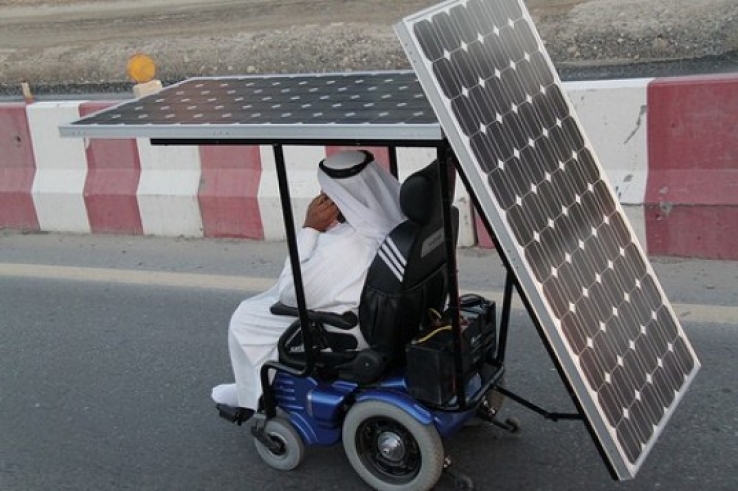
solar-powered wheelchair


Hot wheels: who can invent a better solar-powered wheelchair?

A 2010 solar-power wheelchair- can you do better?
People with celebral palsy were asked for ideas, as part of World Cerebral Palsy Day, for things that could make their lives easier and better, with a solar powered wheelchair one of the top 3 ideas from hundreds submitted shortlisted for development – perhaps by you!
The world’s first World Cerebral Palsy Day was on the 4th of September 2012, earlier this year, with the day’s theme of “Change my world in 1 minute!” setting off more than a year-long series of activities to bring real change to the next World Cerebral Palsy (CP) Day on the 3rd of September 2013.

Throughout August and September this year, the World Cerebral Palsy Day site states that “people with cerebral palsy were given the opportunity to express what they needed to make their lives more independent or rewarding. Those ideas were posted here, and participants were asked to vote for the ideas they liked the best.”

According to the site, we’re now up to Stage 4 in a five stage process, with the previous three stages being the posting of ideas, voting on those ideas, and then announcing the shortlist.

The announced ideas are, in order of their shortlisting (as seen at the site link above or below):

1. A fold-up motorised wheelchair
2. A documentary entitled "Cerebral Palsy in the 21st Century
3. A wheelchair with solar-power
At this fourth stage, announced today, the Day's organisers are inviting "social activists, researchers, inventors, and innovators to propose how they would make these shortlisted ideas become reality", also described as “people with the expertise and resources to create any of the three shortlisted ideas”, with those able to seriously and generously do so asked to register at the World PC Day site. 
A total $25,000 prize pool is also on offer, and will be “shared across the three selected ideas to those that can best bring them to life”, meaning “one prize per category".

The end of March next year is the deadline for inventive new creations (a working prototype) to be submitted and reviewed, with a winner chosen for each idea that "successfully replicates the shortlisted idea" and announced on Friday the 19th of April, 2013, at the World CP Day site.

The site then notes that: "Progress on the commercial production and availability of the winning creations will be updated via the World Cerebral Palsy Day website, social media, print and broadcast media."

Aspirant entrant inventors, be they one-stop invention shops or part of a larger team, are advised to read the FAQ before and after pressing the pinking purple "I can invent this" button, with the application page protected by 'captchas' to prevent bots from their automated digital mischief.

Marcus Blease, World CP Day Panel member from Australia’s Cerebral Palsy Alliance and said in the media release that: “Of the many worthy ideas submitted online, we thought these three had the greatest potential to change the lives of the 17 million people around the globe living with cerebral palsy. 

“In addition, these three ideas have potential to be commercially viable and one day be available on the open market place for people with cerebral palsy. 

“People with cerebral palsy have played their part in coming up with potential ideas, now it’s up to the world’s best minds to turn these shortlisted ideas into reality.

‘This is a unique opportunity for creative minds from across the globe to come together and be a part of something truly life changing’, continued Mr Blease.

“Whether you are an engineer, a designer, a film maker, a business entrepreneur, or a university student or group, we want to hear from you if you think you have the skills to turn one of the shortlisted ideas into reality.

“This opportunity is equivalent to chart-topping artists finding stardom through a talent TV show, with the big exception that success on this stage will change the lives of 17 million people around the world living with cerebral palsy.”

Sounds like a very worthy cause that could certainly end up helping each Australian child born with cerebral palsy every 15 hours, the 17 million people around the world with cerebral palsy, and the 350 million people “who are closely connected to a child or adult with CP”.

The two wheelchairs would also help anyone that ever has the need for a wheelchair in fold-up form, solar-powered form or perhaps even both in the one unit!

Wouldn’t that be something that could help make the lives of people with wheelchairs so much easier and more convenient.

Some kind of easily deployable, or removable but wired solar panels are things that are in my mind, so the wheelchair doesn’t have to be in the hot sun to recharge.

Wireless solar panels to charge a battery, could that be done? Or retractable solar panel(s) of enough size and efficiency… and what about the batteries and their charge?

These are but some of the ideas that immediately flow through my mind…
You’d also want to check up on Google to see what others have already accomplished with solar wheelchairs, including a 200 mile trek in a solar power wheelchair, with large panels in 2010, created by a polio sufferer in the UAE, for ideas on how to create your own innovative new, smaller and sophisticated model!

In addition, the documentary would undoubtedly shine new light on the lives of those with cerebral palsy and would hopefully help to ignite even more creativity and new invention from across the globe to not only improve the lives of people with cerebral palsy in a genuinely meaningful way, but also to benefit everyone else that could use and would welcome the same technologies in their lives, too.

With so much interconnectivity and collaborative potential between the world’s billions of people, what a wonderful time to launch such a great initiative.

I truly hope this day and creative challenge finds the keen and inventive minds it seeks in the quest to make these three ideas a reality by March next year – who knows, it may well be you, from whichever corner of globe you’re reading this from!

reference-hotwheels

Tuesday, 4 December 2012

Graphene Towers Promise "Flexi-Electronics"


3-D graphene blocks—grown between forming ice crystals—add elasticity to the super strength and conductivity of sheets of graphene, a 2-D form of carbon first isolated less than a decade ago

grapheneThe graphene towers' honeycomb structure gives it super strength and resilience.Image: L. Qiu, Monash University
It can support 50,000 times its own weight, springs back into shape after being compressed by up to 80% and has a density much lower than most comparable metal-based materials. A new superelastic, three-dimensional form of graphene can even conduct electricity, paving the way for flexible electronics, researchers say.
The team, led by Dan Li, a materials engineer at Monash University in Clayton, Australia, coaxed 1-centimeter-high graphene blocks or 'monoliths' from tiny flakes of graphene oxide, using ice crystals as templates. The work is published today inNature Communications.
Graphene, a two-dimensional form of carbon that was first isolated less than a decade ago, has exceptional mechanical strength and electrical conductivity, but making use of these properties means first finding ways to scale up from nano-sized flakes (see ‘Graphene spun into metre-long fibers’).
Li and his colleagues adapted an industrial technique called freeze casting to do just that. This involves growing layers of an oxygen-coated, soluble version of graphene called graphene oxide between forming ice crystals. On cooling the aqueous solution of graphene oxide flakes, a thin layer of the nanomaterial becomes trapped between the growing crystals, forming a continuous network that retains its structure once the ice is thawed.
Researchers have used this method before, but the resulting material had poor mechanical strength — a property that Li attributes to the oxygen layer that coats each flake, which weakens bonding between neighboring flakes in the network.        
In the latest study, researchers show that by partially stripping the oxygen coating before freeze casting, they could enhance the bonding between adjacent flakes in the network, producing much stronger materials.
After freeze casting, the honeycomb-like network held its shape as the ice was removed. The researchers could then chemically convert the graphene oxide into graphene, strengthening inter-sheet bonding, and so the material itself, still further.
Fill the void
Li attributes the new graphene's properties to its structure: the individual graphene sheets are neatly aligned, forming an ordered network of hexagonal pores.
Rodney Ruoff, a researcher in graphene assemblies at the University of Texas at Austin, says that the material “is very interesting for the extremely low density that the researchers achieve, as well as its exceptional mechanics”. He adds that the structure could be used as a scaffold for flexible battery electrodes, or form the basis of many composite materials. “It would be interesting to fill the pores with rubber materials, for example,” he says. “There is a great interest in making rubber thermally or electrically conductive without harming its elastic properties.”
Li says that the superelastic graphene has potential for use in biomedical applications. “Biomaterials people are very interested in this structure because the pore sizes match existing tissue scaffolds very well,” he says.
This article is reproduced with permission from the magazine Nature. The article wasfirst published on December 4, 2012.

Friday, 30 November 2012

IIT-Bombay to power up Aakash-2 tablets for Indian classrooms

MUMBAI:

 Amid the unending debate over whether Aakash-2 was made in China, Canada or India, the tablet's first consignment sent to the Indian Institute of Technology-Bombay is ready to be powered with stacks of applications for Indian classrooms. The government has bought the first batch of 10,000 shoe-size Aakash-2 tablets, each costing $40 (2,200). 

Since 2000, the government has been trying to change the stationery in the country's classrooms. It started with the $10 (550)computing device launched in Tirupati in 2009. Then came the $35 (1,925.20) Aakash-1 device that was touted to be India's iPad killer (Aakash was originally called Sakshaat— 'right in front of you') or it's bigger globally-created brother, launched at the UN yesterday. 

As a part of that exercise to "revolutionize education", A-2 will not be sold in the market. Instead, close to 20,000 engineering students will be given A-2 to build a fuller machine for the higher versions of Aakash. Head of Kanwal Rekhi School of Information Technology at IIT-Bombay, Deepak Phatak, is piloting this project with 11,000 teachers and 20,000 students. 

Meanwhile, IIT-Madras's professor Ashok Jhunjhunwala, who is developing Aakash-3, says the upcoming gadget will be remarkably different. For one, it will have multiple manufacturers with a larger distribution system as the order will be a lot bigger. "There will be larger accountability, and repair workshops in various parts of the country so that a student does not have to post it back to the manufacturer. We'll develop a product that is more mature, rugged and reliable." He adds that when A-3 is out "in a few months", an eco system of applications will be ready, new teaching methods and learning methodologies would have been developed and deals inked with content developers. 

Phatak, whose dream is "to see a resurgent India catching up with the world using IT", is in charge after IIT-Jodhpur director Prem Kumar Kalra was pulled off it. "Thousands of apps will be developed on Aakash-2. I wish to clarify that Aakash-2 is a pilot we undertook to develop apps; the government has paid for them in toto." The applications and the content, which promise to alter the topography of education in India, will be 100 % Indian."It's the human contribution that a lot of people are going to make that'll lead to change in education." Teaching methods in schools, medical schools, will change. 

Made in India, China or Canada? 


While parts of Aakash came from China and Canada, as confessed by Datawind CEO Suneet Singh Tuli, faculty members from engineering colleges say that India does not make components for tablets and most complex machines are of global make. 

Former director of IIT-Delhi PV Indiresan says, "We don't make any parts in India and almost all of it comes from elsewhere." He feels that if the digital divide is bridged, most problems set in India's education system will have an answer. "A computing device is going to be an important tool."C Amarnath, who heads SINE, the Innova8tion, Entrepreneurship and Incubation Centre at IIT-Bombay, points out that Ganesha idols come from China today too. "If you bring in sentiments into business, it won't work. 

Today, even Japan sources a lot from China." Similar sentiments are echoed by IIT-B director Devang Khakhar, who says that the crux of the matter was that the tablet was relevant to engineering students. "A lot of parts of the tablet have come from across the globe and assembled here. That is the case with most products today." 

Packed with many more features 

Aakash-2 is packed with many more features than its previous edition. For one, a click allows a teacher to conduct an instant quiz in the class. A professor can post a question and students need to answer the same on their tablet. 

The data is collated within seconds and it allows the teacher to find out who got it right and who did not follow what was taught.


REFER HERE

Tuesday, 27 November 2012

SCIENTIFIC INVENTION


Waxing Innovative: Researchers Pump Up Artificial Muscles Using Paraffin
Artificial muscles have mostly been flaccid as a replacement for motors. Could carbon nanotube yarns soaked in paraffin wax change this? 
When Scientific American heard from chemist Ray Baughman a year ago, he and his international team of nanotechnologists had taken artificial-muscle technology to the next level. Their innovation relied on spinning lengths of carbon nanotubes into buff yarns whose twisting and untwisting mimicked natural muscles found in an elephant's trunk or a squid's tentacles.

Now the researchers are reporting a new artificial muscle–building technique that makes their carbon nanotube yarns several times faster and more powerful. These qualities could help deliver on the technology's promise of developing compact, lightweight actuators for robots, exoskeletons and other mechanical devices, although several challenges remain.

The latest breakthrough comes from infusing the carbon nanotube yarns with paraffin wax that expands when heated, enabling the artificial muscles to lift more than 100,000 times their own weight and generate 85 times more mechanical power during contraction than mammalian skeletal muscles of comparable size, according to the researchers, whose latest work is published in the November 16 issue of Science.

The previous-generation artificial muscles were electrochemical and functioned like a supercapacitor. When a charge was injected into the carbon nanotube yarn, ions from a liquid electrolyte diffused into the yarn, causing it to expand in volume and contract in length, says Baughman, director of the University of Texas at Dallas's Alan G. MacDiarmid NanoTech Institute. Unfortunately, using an electrolyte limited the temperature range in which the muscle could function. At colder temperatures the electrolyte would solidify, slowing down the muscle; if too hot, the electrolyte would degrade. It also needed a container, which added weight to the artificial-muscle system.

The wax eliminates the need for an electrolyte, making the artificial muscle lighter, stronger and more responsive. When heat or a light pulse is applied to a wax-impregnated yarn about 200 microns in diameter (roughly twice that of a human hair), the wax melts and expands. In about 25 milliseconds this expansion creates pressure causing the yarn's individual nanotube threads to twist and the yarn's length to contract. Any weightlifter will tell you that the success of any muscle—artificial or natural—depends in part on the degree of this contraction. Depending on the force exerted, the Baughman team's muscle strands could contract by up to 10 percent.

Muscles are also judged by the weight they can lift relative to their size. "Our muscles can lift about 200 times the weight of a similar-size natural muscle," Baughman says, adding that the wax-infused artificial muscles can also generate 30 times the maximum power of their electrolyte-powered predecessors.

The researchers' latest artificial muscles move the technology closer to commercialized products such as environmental sensors, aerospace materials and even textiles that take can take advantage of nanoscale actuators, University of Cincinnati mechanical engineering professor Mark Schulz, wrote in a related SciencePerspectives article. This new artificial muscle outperforms existing ones, allowing possible applications such as linear and rotary motors; it also might replace biological muscle tissue if biocompatibility can be established, he adds.

However, Schulz points out—and Baughman is quick to acknowledge—that even this new crop of artificial muscles faces many challenges before they can be a practical alternative to mini–electric motors in many of the products we buy. Despite their improvements, the latest artificial muscles are for the most part inefficient and limited in the combinations of force, motion and speed they can generate, according to Schulz.

Indeed, these new artificial muscles operate at about 1 percent efficiency, a number Baughman and his colleagues want to increase at least 10-fold. An option for improving efficiency is to use a chemical fuel rather than electricity to power the muscles. "One way to compensate for a lack of efficiency is to use fuel like methanol instead of a battery," he says. "You could store more than 20 percent more energy in a fuel like methanol than you can in a battery."

Another challenge is that the artificial muscles must be heated and cooled to contract and release, respectively. Short lengths of yarn can cool on their own in a matter of seconds, but longer pieces would need to be actively cooled using water or air, otherwise the muscle would not relax. "Or you'd need [to use a] material that doesn't require thermal actuation," Baughman says. "If you keep making the [carbon nanotube] yarn longer and longer, your cooling rate increases."

This issue of scale poses perhaps the greatest challenge. A one-millimeter length of artificial muscle can lift about 50 grams, according to Baughman. That means lifting several tons would require a greater length of carbon nanotube yarn than is practical. "We'd like our artificial muscles to be used in exoskeletons that help workers or soldiers lift objects weighing tons," he says. But the researchers are still working out ways to pack enough yarn to perform such tasks into the length of an exoskeletal limb.

Carbon nanotube artificial muscles are more likely to first appear in products requiring only short lengths. Baughman envisions artificial muscles used in a catheter for minimally invasive surgery, "where you want to have lots of functionality on the end of the catheter to do surgical manipulations." Another application with flex appeal—"smart" fabrics that can automatically react to their environments, becoming more or less porous when they detect heat or harmful chemicals in the air.